Friday, February 15, 2008

Saturday, February 02, 2008
Mozart Piano Sonata K576, D major
(this piece is also played by Nodame in Nodame Cantabile (Europe special)
Friday, January 11, 2008
Advice from Jim Brickman

Do you have any advice right now for aspiring musicians?
Well, I mean the best advice to any aspiring musician is to just get out there and play, and so many people say, "You know if I just lived in LA or something, I would be discovered," or something, but it's not true. It's really just getting out there. And the problem is that now with things like American Idol, people think that it's, you know, a contest rather than just getting out there and doing what you love to do. And the more you do it, whether it's a wedding or a smokey bar or whatever, you get better and better at it every day that you do it and you get better in front of people. You get more experience and it's really a matter of just getting out there. It's not who you know, it's just... working hard and showing people what you can do in any situation you can find.
When did you write your first song?
I started writing as a teenager. Most of it was imitation. It would be my melodies, but the words would be stolen or grabbed from somewhere else to try and formulate my idea at the time of what I thought a song was. I think that most people would tell you that to be a really good songwriter, you have to have grown a little bit more beyond your teenage years. If you're a songwriter, and you're a teenager, it tends to be more manufactured because it's not about anything. It's not from a place of reality or of experience; it's from a place of being a really good imitator. What I got really good at was I could imitate anything that I heard. I could play an Elton John song or a Carly Simon song, or a Beatles song. So when you start to compose -- first of all, it's not a choice, it's not a decision -- what happens is you sit there and play other people's stuff and you start going, 'I wonder what would happen if I played this instead of that or this chord. I wonder why they didn't go to that note.' It's inherent. It's the same as writing. It's very similar to what you do. You learn from reading, and you learn from imitating, and you learn stylistically how to form certain structures of the way things should be. And all of a sudden your voice takes shape.
Well, I mean the best advice to any aspiring musician is to just get out there and play, and so many people say, "You know if I just lived in LA or something, I would be discovered," or something, but it's not true. It's really just getting out there. And the problem is that now with things like American Idol, people think that it's, you know, a contest rather than just getting out there and doing what you love to do. And the more you do it, whether it's a wedding or a smokey bar or whatever, you get better and better at it every day that you do it and you get better in front of people. You get more experience and it's really a matter of just getting out there. It's not who you know, it's just... working hard and showing people what you can do in any situation you can find.
When did you write your first song?
I started writing as a teenager. Most of it was imitation. It would be my melodies, but the words would be stolen or grabbed from somewhere else to try and formulate my idea at the time of what I thought a song was. I think that most people would tell you that to be a really good songwriter, you have to have grown a little bit more beyond your teenage years. If you're a songwriter, and you're a teenager, it tends to be more manufactured because it's not about anything. It's not from a place of reality or of experience; it's from a place of being a really good imitator. What I got really good at was I could imitate anything that I heard. I could play an Elton John song or a Carly Simon song, or a Beatles song. So when you start to compose -- first of all, it's not a choice, it's not a decision -- what happens is you sit there and play other people's stuff and you start going, 'I wonder what would happen if I played this instead of that or this chord. I wonder why they didn't go to that note.' It's inherent. It's the same as writing. It's very similar to what you do. You learn from reading, and you learn from imitating, and you learn stylistically how to form certain structures of the way things should be. And all of a sudden your voice takes shape.
When you perform, it looks like you're really lost in the music, even going into an altered state. What would be your ultimate "performance high"?
JB: There are many moments onstage when I forget that I'm there and get lost in the music. You have to let yourself do that to make the music real. I'm beginning to perform with orchestras, and the other night I played with the Pittsburgh Symphony. It was a performance high because it dawned on me that some of the best musicians on earth are playing my music and bringing it to life, translating it heart and soul. It was surreal. It was high. It was spiritual. It was all of those things.
JB: There are many moments onstage when I forget that I'm there and get lost in the music. You have to let yourself do that to make the music real. I'm beginning to perform with orchestras, and the other night I played with the Pittsburgh Symphony. It was a performance high because it dawned on me that some of the best musicians on earth are playing my music and bringing it to life, translating it heart and soul. It was surreal. It was high. It was spiritual. It was all of those things.
Sunday, November 25, 2007
Mozart's Sonata for 2 pianos K448
Mozart's only Sonata for Two Pianos, written in 1781, is a fascinating work - not just musically, but also in ways that the composer could never have imagined. Musically it is widely regarded as one of the composer's finest compositions, described by Alfred Einstein thus:
The art with which the two parts are made completely equal, the play of the
dialogue, the delicacy and refinement of the figuration, the feeling for
sonority in the combination and exploitation of the registers of the two
instruments—all these things exhibit such mastery that this apparently
superficial and entertaining work is at the same time one of the most profound
and most mature of all Mozart’s composition
K448 and The Mozart Effect:
http://www.smart-kit.com/s245/how-the-amazing-mozart-k448-can-increase-your-iq-listen-now/
Pablo Casals and Music Magic
In the book Anatomy of an Illness, the author tells a story of his meeting with Pablo Casals, one of the great musicians of the 20th century shortly before the cellist’s 90th birthday. The author describes that it was almost painful to see the old man as he started his day. His hands were swollen and his fingers were clenched. He suffered from arthritis that was so severe; he needed help even to get dress. His emphysema was evident in his labored breathing. In short, he looked like a very, very frail and drained old man.
Before eating, the old man made way to his piano. With great difficulty he arranged himself on the piano bench. To bring the clenched and swollen fingers on the keyboard seemed impossible.
However, his state changed when he started to play his music, Bach’s Wohltemperierte Klavier. The author states that “The fingers slowly unlocked and reached toward the keys like the buds of a plant toward the sunlight. His back straightened. He seemed to breathe more freely.”
By the time he walked away from the piano he walk straighter, taller and without a trace of a shuffle, as if he has been cured from his illness. In short, his state has totally changed.
Before eating, the old man made way to his piano. With great difficulty he arranged himself on the piano bench. To bring the clenched and swollen fingers on the keyboard seemed impossible.
However, his state changed when he started to play his music, Bach’s Wohltemperierte Klavier. The author states that “The fingers slowly unlocked and reached toward the keys like the buds of a plant toward the sunlight. His back straightened. He seemed to breathe more freely.”
By the time he walked away from the piano he walk straighter, taller and without a trace of a shuffle, as if he has been cured from his illness. In short, his state has totally changed.
Tuesday, November 20, 2007
Tuesday, November 06, 2007
Sunday, October 14, 2007
Glenn Gould [Elyse Mach]
 That is not to say that there were not occasional moments- perhaps when I was giving a concert with an esteemed conductor or playing a solo work in an especially fine hall- when some special feeling took hold of me. I wouldn't deny that. But it didn't happen because the audience was there; it could just as well have happened at rehearsal or in a practice session. I can honestly say that I do not recall ever feeling better about the quality of a performance because of the presence of an audience. Indeed, it's precisely for that reason that when I record, I banish everybody from the studio except the people actually working on the recording....
But I found that even the presence of one person would make me tend to show off and, to that extent, it acutlaly got in the way of the performance. It meant that I was more concerned with their reaction than I was with what I was doing. Consequently, it simply did not serve the musical end. Now if you multiply that one person by two or three thousand at a large concert, you have some idea as to the extent of my reservations about public performances as an appropriate medium for music making.
===========================================
During those concert experiences I had to project that particular piece to a very large audience in most cases and, as a consequence, I had added hairpins - crescendi and diminuendi, and similar un-Bachian affectations- where they didn't need to be; I had exaggerated cadences in order to emphasize the separation of sentences or paragraphs, and so on. In other words, I was making an unnecessarily rhetorical statement about the music, simply as a consequence of having attempted to project it in very spacious acoustic environments.
In a studio, where the pick-up is close to the piano, you can achieve a very similar effect to that which the listener enjoys at home. The relationship of the piano to a microphone which is, eight feet away is very similar to the relationship between the listener at home and his speakers. There's a one-to-one aspect in both situations. But no such relationship exists when one is sitting on a stage, like the Tchaikovsky Hall in Moscow, and projecting a Bach partita to the first row of seats and to the top balcony simultaneously.
So the result was that the record made in the summer of '57 is a very glib, facile effort, because a series of little party tricks which just don't need to be there had been added to the piece.
==========================================
What is it about Schoenberg's music that attracts you?
I think I was first attracted to it because some of my teachers hated it; advocacy can be a useful weapon in a teenage rebellion. Actually I've always been attracted to music that is in one way or another contrapntal, whereas I'm essentially bored by homophonic music. Indeed, I've often said that I have something like a century-long blind spot with regard to music. ..........
.......
When my recording of the complete Mozart sonatas was released recently, I devoted about 7000 words to explaining why I really don't like Mozart's music very much. And one of the main reasons, certainly, is that it's not especially contrapuntal and worked out, so to speak. When I have to deal with such music, I confess that I tend to emphasize tenor parts to alto parts- anything to give it the semblance of a contrapuntal presence, to give it the illusion of a polyphonic lay-out.
==============================================
What about the format, the representation, for example, of the recital? There are rumours that the recital format is out, or at least is on the way out.
Well I don't go to concerts- I rarely did, even when I was giving them, .... so I can't honestly tell you that such a format has no validity in today's scheme of things. But it doesn't for me, certainly; as far as I'm concerned, music is something that ought to be listened to in private. I do not believe that it should be treated as group therapy or any other kind of communcal experience. I think that music ought to lead the listener- and, indeed, the performer- to a state of contemplation, and I don't think it's really possible to attain that condition with 2999 other souls sitting around. So my strongest objections to the concert are primarily moral rather than musical. But as far as the format of the recital is concerned, I personally don't particularly relish a sequence of the same instrumental sounds all evening, especially if htey're piano sounds. There are, as you well know, many piano freaks. I just don't happen to be one of them. I don't much care for piano music.
You don't care much for the music from the instrument you play? That's hard to believe.
Well, I'm really not hooked on the instrument per se- on any instrument, per se. I'm kind of instrumentally indifferent, I guess. Of course, if I hear a very scintillating performance I get great pleasure from it; I certainly don't mean to say that I don't get pleasure from listening to performances that involve the piano, but I don't get pleasure from performances because they invovle the piano. And I think that that really has laways been true. I've never been a piano buff in that sense.
================================================
What are you like outside the recording studio? What is your lifestyle?
First of all, I can't divorce the studio from my personal life. The recording studio and the kind of womblike security that it gives is very much integrated with my lifestyle. I guess tis' all part of my fantasy to develop to the fullest extent a kind of Howard Hughesian secrecy. I'm a very private person, I think, I'm alone, or quasi-alone, a lot because the recording studio, with its small crew, provides me with the atmosphere that I need to work productively- to make music or indeed, to work on a radio or tv program. I stay up all night mostly. I very rarely go to bed until 5 or 6 oclock in the morning, and it's not unusual for me to hear the headlines on "Today Show" before turning in. I tend to get up around three in the afternoon.
===============================================
What about your views in areas other than music? Your views, for example, on a life hereafter?
I can only say that I was brought up as a Presbyterian; I stopped being a church-goer at the age of about 18, but I have had all my life a tremendously strong sense that, indeed , there is a hereafter, and the transformation of the spirit is a phenomenon with which one must reckon, and in the light of which, indeed, one must attempt to live one's life. As a consequence, I find all here-and-now philosphies repellent. On the other hand, I don't have any objective images to build around my notion of a hereafter, and I recognise that it's a great temptationto formulate a comforting theory of eternal life, so as to reconsile one's self to the inevitability of deat. But I'd like to think that's not what I'm doing; I'd like to think that I'm not emplying it as a deliverate self-reassuring process. For me, it intuitively seems right; I've never had to work at convincing myself about the likelihood of a life hereafter. It is simply something that appears to me infinitely more plausible than its opposite, which would be oblivion.
=====================================================
The term eccentric has been applied to you many times. How do you react to it?
I don't think that my life style is like most other people's and I'm rather glad for that; I think it's in some way integrated with the kind of work that I want to do. As I said previously, the two things, life style and work, have become one. Now if that's eccentricity, then I'm eccentric. If eccentricity consists of wearing a scarf in an air-conditioned environment while recording, or playing with an overcoat on during my stay in Jerusalem, I'm guilty; but those things are organic to what I have to do.
Monday, October 08, 2007
Great conversations: the pianists / Eugene Istomin [video recording]

ROSEN:
The way Schnabel used to practice... he rarely practiced the really difficult passages. What he would do is practice the chords in something like the opening chords of the slow movement of the Op. 106.32 And what happened, he practiced them for the balance of sound. And in the end, that's really what the key to a beautiful tone, tone is. I mean, he would practice it until the chord vibrated from it, until the harmonics of the chord started to come out, until the chord sang the way he needed to make it. I mean, what I'm trying to say is, there's a vertical component, which is, you know, how the chord and how the chord vibrates and how the harmonics work in the thing-- and then, of course, there's the horizontal component of shaping the melody. If one of the notes sticks out too much, that sounds like banging. I mean, if you do it wrong. Also, when playing a chord, if you do this [gestures], just play all the notes equally, it's, it tends to be disagreeable. You have to use it only for a special effect. Can I add one small thing, which is that, I mean, what most people mean by a beautiful tone is that you bring out the melody and you use the pedal. And I mean, that's what a lot of teachers do. And I mean, to a certain extent, for a good deal of music, this is a good idea. But the whole, the way music is taught, not only in this country but around the world, which is that you use the same kind of sound for Bach, Beethoven, Mozart, Haydn, Boulez, Debussy, you know, Chopin. It becomes ridiculous. I mean, there should be a different sound for each composer.
The way Schnabel used to practice... he rarely practiced the really difficult passages. What he would do is practice the chords in something like the opening chords of the slow movement of the Op. 106.32 And what happened, he practiced them for the balance of sound. And in the end, that's really what the key to a beautiful tone, tone is. I mean, he would practice it until the chord vibrated from it, until the harmonics of the chord started to come out, until the chord sang the way he needed to make it. I mean, what I'm trying to say is, there's a vertical component, which is, you know, how the chord and how the chord vibrates and how the harmonics work in the thing-- and then, of course, there's the horizontal component of shaping the melody. If one of the notes sticks out too much, that sounds like banging. I mean, if you do it wrong. Also, when playing a chord, if you do this [gestures], just play all the notes equally, it's, it tends to be disagreeable. You have to use it only for a special effect. Can I add one small thing, which is that, I mean, what most people mean by a beautiful tone is that you bring out the melody and you use the pedal. And I mean, that's what a lot of teachers do. And I mean, to a certain extent, for a good deal of music, this is a good idea. But the whole, the way music is taught, not only in this country but around the world, which is that you use the same kind of sound for Bach, Beethoven, Mozart, Haydn, Boulez, Debussy, you know, Chopin. It becomes ridiculous. I mean, there should be a different sound for each composer.
FLEISHER:
The wonderful thing, the problem, I think, or one of our challenges is: Music is a horizontal activity, and yet it's the piano, the unique instrument that produces horizontal activity through a totally vertical, totally vertical activity. Violin: horizontal. Blowing air, from piccolo to tuba, is horizontal, in a sense. Putting down 88 keys is totally vertical.
The wonderful thing, the problem, I think, or one of our challenges is: Music is a horizontal activity, and yet it's the piano, the unique instrument that produces horizontal activity through a totally vertical, totally vertical activity. Violin: horizontal. Blowing air, from piccolo to tuba, is horizontal, in a sense. Putting down 88 keys is totally vertical.
=========================================================
ROSEN:
We all come from families which were immigrant families, too. I mean, there's the second displacement, in other words, that we came from families that were displaced. It's what I said, that-- now, actually, most of the students in conservatories like Juilliard, they come from displaced families from Korea and Japan, and they're an entirely different-- the tradition hasn't changed. I mean, what happens is that music for immigrant families, classical music had a certain prestige, it was a way of sort of arising in society, and we were encouraged by our parents, and, you know, "my son, the pianist," or, instead of saying "my son the doctor" or "my son the nuclear physicist." And so that was a help. And that basically, there was, this is important, I think, for people to understand-- there was a whole transference of the European tradition not just in music but in everything: in nuclear physics, in mathematics. I mean, after 19...after Hitler, after 1938 and the Russian Revolution, there was an enormous transference, migration, of intellectuals from Europe into America. And I know American musicology was created at that time, and American pianism of a very special kind. Otherwise, before that, Americans had to go to Europe and study. Now, the European professors came and taught, and taught us here, and that was a big thing.
Monday, August 27, 2007
Thursday, April 26, 2007
Lynn Harrell - Comparing cello to a singer
You have, on a number of occasions compared playing the cello to a singer and his or her techniques. Could you elaborate on that?
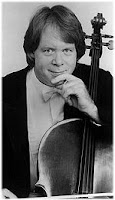
Certainly. It's my favourite subject. I think when people hear string playing and they like it, they're moved by it, it's because the string player has a sense of making the string instrument sound and speak and sing like a singer. So there are aspects of singing and speaking that are things we should try to copy and emulate.
...I sense those things and the connections of a good singer to playing a string instrument in a vocal way.
The variety of consonants in language, and the variety of colour of vowels - from the difference in vowels in French, German, Italian, they're just so many colours. The beginning of a breath should sound different than the end of a breath because if it sounds the same it's not a living breathing, alive animal. Sometimes that's extended so a string player is bound to just hold a note and its kind of an abstraction. And vibrato is a natural function of singing, so sometimes you vibrate on a string instrument very fast like a soprano, or sometimes very slowly like a bass singer. Of course when you vibrate very slowly and you're playing in the high register, it just sounds like a very fat over-the-top Wagnerian soprano who should've stopped singing twenty years ago. Which is of course funny. We all think of that as funny. So I can make people laugh by demonstrating (and he does that here, singing… "ooohhh") kind of vibrato. But it's appropriate in certain very low notes, because that's what happens with the bass singer down in the very deep register, where it vibrate much more slowly.
So there's breath, there's colour, there's articulation, and there's rhythm. The notation of music is divided mathematically by twos and threes. But there's a lot in between a two and a three. There's a lot in between that. And of course, there is in language and speech and poetry, there's sense that we can alter, with an educated guess, a classical rhythmic function much like in the La Mer (which was being rehearsed next door, and he demonstrates with notes from more vibrant to languid styles rhythm).

Certainly. It's my favourite subject. I think when people hear string playing and they like it, they're moved by it, it's because the string player has a sense of making the string instrument sound and speak and sing like a singer. So there are aspects of singing and speaking that are things we should try to copy and emulate.
...I sense those things and the connections of a good singer to playing a string instrument in a vocal way.
The variety of consonants in language, and the variety of colour of vowels - from the difference in vowels in French, German, Italian, they're just so many colours. The beginning of a breath should sound different than the end of a breath because if it sounds the same it's not a living breathing, alive animal. Sometimes that's extended so a string player is bound to just hold a note and its kind of an abstraction. And vibrato is a natural function of singing, so sometimes you vibrate on a string instrument very fast like a soprano, or sometimes very slowly like a bass singer. Of course when you vibrate very slowly and you're playing in the high register, it just sounds like a very fat over-the-top Wagnerian soprano who should've stopped singing twenty years ago. Which is of course funny. We all think of that as funny. So I can make people laugh by demonstrating (and he does that here, singing… "ooohhh") kind of vibrato. But it's appropriate in certain very low notes, because that's what happens with the bass singer down in the very deep register, where it vibrate much more slowly.
So there's breath, there's colour, there's articulation, and there's rhythm. The notation of music is divided mathematically by twos and threes. But there's a lot in between a two and a three. There's a lot in between that. And of course, there is in language and speech and poetry, there's sense that we can alter, with an educated guess, a classical rhythmic function much like in the La Mer (which was being rehearsed next door, and he demonstrates with notes from more vibrant to languid styles rhythm).
Tuesday, April 24, 2007
Piano Trek

Stage, the final frontier.
These are the voyages of a mad woman and her piano.
Her ongoing mission: to explore strange new mistakes and to seek out ways to survive to them during the performance
To boldly play like no one has played before
These are the voyages of a mad woman and her piano.
Her ongoing mission: to explore strange new mistakes and to seek out ways to survive to them during the performance
To boldly play like no one has played before
Thursday, April 19, 2007
Wondrous Strange: The Life and Art of Glenn Gould

"There is no excellent beauty that hath not some strangeness in the proportion"
~ Sir Francis Bacon
Gould was emotionally reticent even in infancy. He never cried; he hummed instead.
His private motto: "Behind every silver lining there's a cloud"
"My ability to work varies inversely with the niceness of the weather."
He identified himself as a Nordic man, and all things southern and Mediterranean were anathema to him: sunshine and blue skies, spicy food, physical exertion, easy sensuality, emotional openness, Italian opera. He hated bright colours, and equated red with violence; at the age of four or five he flew into a tantrum when someone gave him a red fire engine. His favourite colours were "battleship gray and midnight blue" and he loved black and white movies, including war movies, ....
When he was eight, is parents took him to wee Walt Disney's Fantasia, and he hated its "awful riot of colour" as he recalled years later. "I went home depressed, feeling faintly nauseous, and with the first headache I can remember".
His hands were naturally agile and flexible, and he instinctively guarded them. Even as an infant he would pull them away or turn his back if someone threw or rolled a ball at him. Once, when he was just weven or eight, Jessie Greig asked him to join in a game of marbles. He wanted to play, but when he put his hand down and found the ground cold, he withdrew it at once, and said "I'm afraid I can't".
Gould's first name is frequently misspelled as "Glen",..... and Gould himself used both spellings interchangeably throughout his life. In fact, it is difficult to find a specimen of his signature which a second "n" is clearly discernable. To his record producer Andrew Kazdin, Gould offered a lame explanation: he had discovered early on that if he started to write the second 'n' he would be unable to stop and would end up writing three 'n's.
The organ, Gould later said, gave him a taste for Bach and other early music, and had a profound influence on his piano style. It taught him to "think with his feet", which led to a fondness for bringing out basslines (he was also left-handed, incidentally); taught him to "think of music as being played by three hands - the feet acting as the third hand," which led to a passion for counterpoint unusual among pianists; and it taught him not to pound the keys but to develop a technique based on "the tips of the fingers," to make expressive nuances through slight shifts of tempo instead of dynamics, both of which encouraged his clean, "upright" clearly articulated piano playing.
Arthur Rubinstein was once asked on television what he would wish for if he were given a second chance at life; he replied, " to be born with Glenn Gould's hands."
And there is the testimony of colleagues like Jaime Laredo, who recalled that he was open-mouthed as he listened to Gould play transcriptions between takes in their recording sessions; he thought Gould's technique superior to that of any other pianist.
"He really did have a magnificent technique," Charles Rosen said. "He could have developed terrific octaves quite easily if he'd wanted to. he just didn't want to."
In an interoffice memo from 1981, a Steinway and Sons employee referred to Gould as the one pianist of his generation with "complete tonal command" - comparable to Horowitz - and more than one critic and fellow musician considered his technique to have been perfect, perhaps the greatest of the age.
Still, to acknowledge that Gould could have played Chopin's etudes or Liszt's B-minor sonata or the Rach3 does not mean that he was physically (never mind temperementally) suited to making a career of such music.
=======================================
"I don't want to think too much about my playing or I'll get like that centipede who was asked which foot he moved first and became paralysed, just thinking about it."
=======================================
Glenn's take on his father's relationships, which I believe is spot on in general.
not appropriate for a person to change their spots so radically for the sake of another person
all relationships are addictive - just as much as alcohol or tobacco
one develops what one thinks of as an intense need to be with a particular person, to translate all your activity, everything that you do in the course of a day, and while that may be a fascinating exercise, it's also exhausting and it has one other great disadvantage - that it distracts you from contemplation, from looking inward, to really meditate upon the shape of your life - one doesn't do that (in a relationship) because one thinks one is starting one's life. When a relationship is new, there's a much greater intensity.
=======================================
Gould and Yamaha
He was testing Steinways as late as May 1981, but never found one to replace his old friend (CD318) permanently, not even instruments which has served artists like Rachmaninov and Horowitz. As always he found the new Steinways, especially the American ones, ranged from "terrible to pathetic" in tone or action or both, and he was not the only Steinway artist to complain at this time: the 70s is generally considered to have been the low point in the company's history.
He tested other pianos - German Steinways, Bechsteins - and finally defected to Yamaha. He first tried a Yamaha ...... and was deepley impressed by the piano's action, which had the responsiveness and the minimal aftertouch he craved. He also liked he intimacy, clarity and brightness of Yamaha's tone, and though he did not consider the sound completely satisfactory - he found the bass unfocused - he knew he could work with it.
===========================================
"The Wars" soundtrack
.... the most important classical theme is that of Brahm's tender Intermezzo in E-flat major, Op.117 No.1, which Gould called "Rowena's Theme". When it first appears in the film, it is associated with Robert's beloved, disabled sister Rowena, who dies before he goes off to war - according to Nielsen and Philips, Gould developed one of his obsessive adolescent crushes on Rowena, and was for a time watching one of her scenes every day. Brahms, incidentally, noted that the piece was based on a Scottish folk song, "Sleep Softly, My Child". The theme is woven throughout the score. In its original key, it is assoc with images of farewell, longing, remembrance; Gould wrote, "If you want the musical-mystical-metaphorical significance, E flat major is a key which composers have frequently assoc with the idea of resurrection (he was probably thinking of Mahler's 2nd symph). The theme also appears in Eflat minor, usually in a hauting version for one or two choirboys when someone dies. The theme hovers over the score like the Angel of Death. The score is in fact unified harmonically, with E flat (major and minor) as principal key. The most important Hymn, "Abide With Me" appears in E flat, and when Gould needed a new theme for the sequence involving Harris's ashes he chose Brahm's dark Intermezzo in Eflat minor, Op 118 No6.
==========================================
Gould as conductor
..... wearing layers of shapeless dark jackets, flannel shirts and pants (plural) despite the summer's heat, and carrying a large, gree plastic garbage bag containing his musical score, notepads and paraphernalia.
Wholly dedicated to the music at hand, Gould was not interested, like so many conductors, in matters of power and personality, and so came across unpretentious.
"What struck me the most about my encounter with Glenn was his unfailing politeness and encouragement to the musicians. He was animated, resourceful, inspiring and sympathique throughout. He did his best to make us all feel like partners in the endeavour rather than sidemen to his maestro. We were all on a first name basis. In fact, he had taken time to commit everyone's name to memory before meeting us, and he made sure to shake everyone's hand at the end of the final session, something none of us expected." ~Timothy Maloney, clarinetist
============================================
Gould on Pedalling
"We are not trying to sacrifice in the piano what the harpsichord did not have, but rather to create an impressionistic effect of what the harpsichord did have."
============================================
"I'm not anti-social, but if an artist wants to use his mind for creative work, then self-discipline, in the form of cutting oneself off from society, is a necessary thing."
"These aren't personal eccentricities, they're simply the occupational hazard of a highly subjective business"
"I don't go to concerts, sometimes not even to my own!"
"The greatest of all teachers is the tape recorder"
=
Monday, April 16, 2007
The Art of Possibility
by Rosamund and Benjamin Zander
You need a "catchy" catchphrase, so that you can recall them instantly when the time comes.
Once you are in the habit of using them, these practices will reliably land you back in the boat, reoriented in a universe of possibility.
 Eg: 9 dot puzzle -> Think out of the box!
You need a "catchy" catchphrase, so that you can recall them instantly when the time comes.
Once you are in the habit of using them, these practices will reliably land you back in the boat, reoriented in a universe of possibility.
1. It's All Invented
A shoe factory sends out 2 marketing scouts to Africa to study the prospects for expanding business. One sends back a telegram saying:
SITUATION HOPELESS. NO ONE WEARS SHOES
The other writes back triumphantly:
GLORIOUS BUSINESS OPPORTUNITY. THEY HAVE NO SHOES.
We perceive only the sensations we are programmed to receive, and our awareness is further restricted by the fact that we recognise only those for which we have mental maps or categories.
Eg. Picasso's paintings.
Most people already understand that, as with cultural differences, interpretations of the world vary from individual to individual.
 Eg: 9 dot puzzle -> Think out of the box!
Enlarge the box, create another frame around the data, and problems vanish, while new opportunities appear.
Every story is founded on a network of hidden assumptions.
The puzzle "assumes" you must draw within the square formed by outer dots.
If you learn to notice and distinguish these stories, you will be able to break through the barriers of any "box" that contains unwanted conditions and create conditions that support the life you envision for yourself.
The Practice
Ask yourself:
What assumption am I making, that I'm not aware I'm making, that gives me what I see?
Then ask yourself:
What might I now invent, that I haven't yet invented, that would give me other choices?
Since it's all invented, why not invent something that supports your goals instead of against it?
2. Universe of Possibility
World of measurement
We grow up in a world of measurement, and in this world, we get to know each other and things by measuring them, and by comparing and contrasting them.
And just as virtually everybody adds the clause "within the square formed by the outer dots", virtually everybody, whether living in the lap of luxury or diminished circumstances, wakes up in the morning with the unseen assumption that life is about struggle to survive and get ahead in a world of limited resources.
Universe of Possibility
In the realm of possibility, we gain our knowledge by invention. You attract your label.
The action in a universe of possibility may be characterised as generative/giving - producing new life, creating new ideas. The relationship between people and environments is highlighted, not the things themselves.
You are more likely to be successful , if you participate joyfully with projects and goals and do not think that your life depends on it, because then you will be better able to connect to people all around you. Resources are likely to come to you in greater abundance when you are generous and inclusive. When you are oriented to abundance, you care less about being in control, and you take more risks.
There is no such thing as bad weather, only inappropriate clothing. =P
3. Giving an "A"
"Each student in this class will get an A for the course. However there is one requirement that you must fulfill to earn this grade. Sometime during the next 2 weeks, you must write me a letter dated next May, which begins with the words, "Dear Mr Zander, I got my A because.... " and in this letter you are to tell me, in as much detail as you can, the story of what will have happened to you by next May that is in line with this extraordinary grade. Phrases like 'I hope', 'I intend' or 'I will' must not appear"
" I am especially interested in the person you will have become by next May. I am interested in the attitude, feelings and worldview of that person who will have done all she wished to do or become everything he wanted to be."
The art of music, since it can only be conveyed through interpreters, depends on expressive performance for its lifeblood. Yet it is only when we make mistakes in performance that we can really begin to notice what needs attention. In fact, I actively train my students that when they make a mistake, they are to lift their arms in the air, smile and say, "How fascinating!"
The Secret of Life
The student, in a brilliant flash, had realised that the labels he had been taking so seriously are human inventions. The label C is invented, and the A is invented, so we might as well choose to invent something that brightens our life.
Give yourself an A
When asked what accomplishment he was most proud of, he simply answered,
"That I did the best I could with what I had."
Really, can anyone ask for more?
Giving yourself an A is not about boasting or reciting your accomplishments. The freely granted A lifts you off the success/failure ladder and spirits you away from the world of measurement into the universe of possibility. It is a framework that allows you to see all of who you are and be all of who you are.
Reconstructing Our Past
Re-evaluate the grades we gave others when we were children, the grades we gave our parents. As soon as you have the grace to give people A's, all sorts of thing are revealed that were as though hidden behind a veil. Letters pop out, memories return. There are new openings.
The adage "You can't change people" is true in the world of measurement, where people and things are fixed in character. But in the universe of possibility, you certainly can. They change as you speak. Who is doing the changing? The answer is the relationship. Because in the arena of possibility, everything occurs in that context.
4. Being a contribution
Let's settle on a game called I am a contribution. Unlike success and failure, contribution has no other side. In this new game, it is not important how much money you make. Those concerns are packed away in a box in another dimension. Life operates on a different set of rules.
Describing things as a game is twofold. You shift the context from one of survival to one of opportunity for growth. You also have the choice of imagining other games you'd rather be playing in these realms. Naming your activities as a game breaks their hold on you and puts you in charge. If the rules don't light up your life, put it away, take out another one you like better and play the new game wholeheartedly. Remember, it's all invented.
Like ripples in a pond
Make it a habit to recollect how you made a contribution each day.
There is an aspect of psychological practising in these exercises parallel to the technical practising on the piano. It is a discipline of the spirit.
In order to be a great performer, you have to be unfettered by stage nerves. These exercises in contribution are a way of oiling the machinery to make one a more effective vehicle to convey the message of Brahms or Beethoven.
Imagine you are a pianist and you meet someone who has never heard the E minor Prelude by Chopin. You might want to sit down next to him at the piano and say, "Listen to this". As you get caught up in the excitement of explaining and sharing the music, you would have little time left to be nervous.
5. Leading From Any Chair
Leaders can be anywhere, not necessarily at the podium.
6. Rule Number 6
Don't take yourself so seriously!
Lighten up! Laughter and humour are perhaps the best way we can "get over ourselves".
Remembering Rule No. 6 can help us distinguish and remove the part of ourselves that developed in the competitive environment of the "measurement world", our "calculating self", which lobbies to be taken very seriously indeed. Rule No. 6 coaxes the "calculating self" to lighten up and break its hold on us.
"What would have to change for me to be completely fulfilled?" You recognise your own "calculating self" in action. You stop taking yourself and "your story" so seriously and suddenly able to distinguish people/situations from the diagnosis that you label them.
When somebody gives up their pride/ego to reveal a truth to others, we find it incredibly moving. When one person peels away layers of opinion, entitlement, pride and inflated self-description, others instantly feel the connection. Now with the 'calculating self' revealed and humoured, the 'central self' shines through.
Central Self
Inscribed on five of the six pillars outside the Holocaust Museum at Quincy Market in Boston are stories of survivors. The sixth pillar is about a little girl named Ilse, a childhood friend of Guerda Weissman Kline. Guerda remembers that Ilse, who was about six years-old at the time, found a single raspberry one morning somewhere in the camp. She carried it with her all day long in a protected place in her pocket. That evening, with her eyes shining with happiness, she placed the raspberry on a leaf and gave it to Guerda as a gift. It was the defining moment of Guerda's life. She said, "Imagine a world in which your entire possession is one raspberry, and you give it to your friend."
Calculating self will never be able to appreciate the beauty of nature and the simple things in life. Its attention is on comparison and schemes. But the central self is open, and aware, remarkably generative, prolific and creative nature. An attitude of wholeness and sufficiency.
Rich, free and compassionate.
Rich, free and compassionate.
When we follow Rule No. 6 and lighten up over our childish demands, we are instantly transported to a remarkable universe. For the most part it lies a bit over our heads. Angels can fly there because they take themselves lightly =P
7. The Way Things Are
Being the way things are by clearing "shoulds" and judgements.
Mistakes can be like ice. If we resist them, we may keep on slipping into a posture of defeat. If we include mistakes in our definition of performance, we are likely to glide through them and appreciate the beauty of the longer run.
8. Giving Way to Passion
Giving way to passion has 2 steps:
i) Notice where you are holding back and let go. Release those barriers of self that keep you separate and in control, and let the vital energy of passion surge through you, connecting you to all beyond.
ii) Participate wholly. Allow yourself to be a channel to shape the stream of passion into a new expression for the world.
Long Lines
..... the performer lose his connection to the long line of the music when his attention solely lies on perfecting individual notes and harmonies. Like the person who, mindless that she has all of nature in her fingertips, blocks the expression of life force, so does the musician interrupt the long line of passion when she limits her focus to the expression of personal emotion, local colour or harmonic events.
Leon Fleischer said that playing a piece of music is an exercise in antigravity. The musician's role is to draw the listener's attention over the barlines - which are but artificial divisions, having no relevance for the flow of the music - toward a realisation of the piece as a whole. In order to make the connections between the larger sections of a piece, the player may find herself moving the tempo at a faster pace than if she were putting her attention on highlighting individual notes or vertical harmonies.
One-Buttock Playing
Allow your body to flow sideways, to catch the wave of the music with the shape of your own body.
Even at six, Jacqueline du Pre was a conduit for music to pour through. She had the kind of radical confidence about her own highly personal expression that people acquire when they understand that performance is not about getting your act together, but about opening up to the energy of the audience and of the music, and letting it sing in your unique voice.
BTFI
Beyond the F--- It
I was so pissed of and I said f--- it, I'm going to Madrid to play the audition for the principal cellist, and I won it, at twice the salary!
9. Lighting a Spark
The practice of enrollment is about generating possibility and lighting its spark in others.
i) Imagine that people are an invitation for enrollment
ii) Stand ready to participate, willing to be moved and inspired
iii) Offer that which lights you up
iv) Have no doubt that others are eager to catch the spark
A "no" can often dampen our fire in the world of downward spiral. It can seem like a permanent barrier that presents us with limited choices. In other words "no" can seem like a door slamming instead of merely an instance of the way things are. Yet, were we to take a
"no" less personally, and ourselves less seriously, we might hear something else.
"no" less personally, and ourselves less seriously, we might hear something else.
10. Being the Board
When "The Way Things Are" offers no possibility, when you are angry and blocked, and for all your efforts, others refuse to cooperate, when "enrollment" does not work and you are at your wit's end - you can take out this next practice. In this one, you rename yourself as "the board on which the whole game is being played". You move the problematic aspect of any circumstances from the outside world inside the boundaries of yourself.
Declare: " I am the framework for everything that happens in my life."
"If i cannot be present without resistance to the way things are and act effectively, if I feel myself to be wronged, a loser or a victim, I will tell myself that some assumption I have made is the source of my difficulty."
Grace comes from owning the risk we take in a world by and large immune to our control.
Gracing yourself with responsibility for everything that happens in your life leaves your spirit whole, and leaves you free to choose again.
.... Besides I know full well that every time I step onto a podium, I take a risk that things won't turn out exactly as I anticipate them in my ear......
The type of responsibility we are most familiar with is the sort that we apportion to ourselves and others. Dividing obligations helps us keeping life organised and manageable. Because the model is based on the assumption that life will be under control if everyone plays his part, when things DO break down, someone or something naturally gets blamed.
The next step: ask yourself, "how did this get on the board that I am?"; "How is it that I have become a context for that to occur?"
You will begin to see the obvious and the not-so-obvious contributions of your "calculating self", or of your history, or earlier decisions. And then you will be standing freely and powerfully once again in a universe of possibility.
You look around and say "It's nothing personal that xxxx. It's a certain statistical probability that...... "
"Being the board" is not about turning the blame on yourself.
Saturday, March 31, 2007
Lili Kraus
 http://www.bach-cantatas.com/Bio/Kraus-Lili.htm
 Great Contemporary Pianists Speak for Themselves (Elyse Mach)
Without those experiences, I would never have achieved the depths of compassion and, on the other hand, the appreciation of the richness of life that fills my sould and spirit ever since liberation, to this day. Depth may not be the right word either; perhaps immediate or irresistable come closer to my meaning. The gratitude for having a clean cup like the one I'm holding; and the countless wonders, considered trivial, could never, never have grown to the degree of gratitude and enthusiasm with which hey now occur.
Indeed, gratitude and enthusiasm rule my life as they do my performances; they appear in my teaching; and they trigger my understanding of composers - I give them all I have and thank them with all I am for the privilege of being their interpreter.
===========================================
When I walk out and see the friendly grin of those 88 keys assuring me, inviting me, I love them and then everything falls into place.
I never eat anything before a performance because I believe that every fiber of your body has to serve the performance and you cannot burden your stomach by making your digestive juices work. If you do, you function too much in the stomach and not enough in the spirit and the brain.
During the performance, this person you see before you, this Lili Kraus, ceases to exist as an individual. I exist only in the music I project to the audience.
========================================
The piano really is a marvelous instrument. In a way it is not only the most sphisticated, but also the most transcendental of all instruments, because it forces you to rely not on technique only, as many would have it today, but on your creative imagination almost to the point of sorcery. The paradox lies in the fact that the voice of the piano dies in the moment of birth. Once you have struck the key, the sound can only diminish; there is no way of actually prolonging it. It is up to your imagination and vision to pretend and make believe that there is a continuity of sound equivalent to the sound of a flute, a voice, a cello, a horn, in fact, a whole orchestra. So the piano has all the richness imaginable besides the polyphony it can produce.
========================================
Mozart has given this gift of sweetness, which is so extraordinary because it is born out of tragedy. I feel an affinity to Mozart because he, like myself, had an almost unbearable sensitivity for all suffering around him, if I dare to speak myself in the same breath with his name. ......
In his diary, Leonardo da Vinci said that the true experience of the artist at times is so terrifying that, if the artistic vision were presented in full truth to the layman, he would be so shocked that he would flee in terror. Therefore, according to Leonardo, it is the duty and sacred privilege of the creative artist to cloak his experience in the garb of love and perfection. Now this is precisely what Mozart has done, and his music has become so much a part of me that I agonize when the music turns minor, and I'm redeemed when it reverts to the major.
Wednesday, March 28, 2007
Glenn Gould Hall of Fame
Glenn Gould- Phone fetish
http://www.stim.com/Stim-x/0896August/Sparky/gould.html
Glenn Gould: The Man by Jessie G. Greig
http://www.rci.rutgers.edu/~mwatts/glenn/jessie.html
Writings and Works, etc by and about Glenn Gould
http://www.rci.rutgers.edu/~mwatts/glenn/articles.html
http://www.stim.com/Stim-x/0896August/Sparky/gould.html
Glenn Gould: The Man by Jessie G. Greig
http://www.rci.rutgers.edu/~mwatts/glenn/jessie.html
Writings and Works, etc by and about Glenn Gould
http://www.rci.rutgers.edu/~mwatts/glenn/articles.html
Monday, March 26, 2007
The Cliburn: "Encore! with James Conlon"
Being it or playing it
Being: existing, incarnating, acting
Playing: pretending, simulating, recreating
Is it to be? Or to play?
Do I play the music? Or am I the music?
Do I become the music? Or do I just play the music?
As an interpreter, there is a constant dynamism between just identifying with the music, becoming spiritually at one with the music and at the same time just playing it, just doing it.
We need to feel identification, we do identify with the composition. We make it our own, we speak of it, making it our own. First of all you practice to a point where you have it "in your hands" and the time that it takes to do that you develop an emotional relationship, as if you had been conversing with that piece, as if that piece had been talking to you, and you're talking back to it.
So you have the illusion that that piece belongs to you, these are words, you hear these things said, "that's my piece", or "that's his piece" or "that's her piece".
I prefer to think of it as the interpreter, having surrenderred his or her ego to the piece, so that the piece can flow into your own person as fully as possible. So naturally, at that moment, you feel that you are a part of that piece, you are that piece and you feel yourself disappear into that piece.
Now, does that make a good performance, or does that make you a good performer?
The answer is no, it's not enough. Because at the same time, you have to have enough distance from your experience of the piece in order to actually execute it. You still have to play the notes, you may miss some, that's ok, but you still have to play them.
This is an illusion that we have, however, when we perform a piece of music to which we identify, because we have, at that moment, the impression that we are at one with the composition, at one with the composer, and in a way maybe that's necessary.
Just the way and actor could imagine to believe he's Hamlet. Certainly he makes us believe he's Hamlet .....
Being: existing, incarnating, acting
Playing: pretending, simulating, recreating
Is it to be? Or to play?
Do I play the music? Or am I the music?
Do I become the music? Or do I just play the music?
As an interpreter, there is a constant dynamism between just identifying with the music, becoming spiritually at one with the music and at the same time just playing it, just doing it.
We need to feel identification, we do identify with the composition. We make it our own, we speak of it, making it our own. First of all you practice to a point where you have it "in your hands" and the time that it takes to do that you develop an emotional relationship, as if you had been conversing with that piece, as if that piece had been talking to you, and you're talking back to it.
So you have the illusion that that piece belongs to you, these are words, you hear these things said, "that's my piece", or "that's his piece" or "that's her piece".
I prefer to think of it as the interpreter, having surrenderred his or her ego to the piece, so that the piece can flow into your own person as fully as possible. So naturally, at that moment, you feel that you are a part of that piece, you are that piece and you feel yourself disappear into that piece.
Now, does that make a good performance, or does that make you a good performer?
The answer is no, it's not enough. Because at the same time, you have to have enough distance from your experience of the piece in order to actually execute it. You still have to play the notes, you may miss some, that's ok, but you still have to play them.
This is an illusion that we have, however, when we perform a piece of music to which we identify, because we have, at that moment, the impression that we are at one with the composition, at one with the composer, and in a way maybe that's necessary.
Just the way and actor could imagine to believe he's Hamlet. Certainly he makes us believe he's Hamlet .....
Monday, March 19, 2007

Professor Benjamin Zander, Founder and Conductor of Boston Philharmonic Orchestra:
"You are all going to get an "A"! Part of you getting that "A" will be that in the next 2 weeks you write me a comprehensive letter. You will imagine yourself having just graduated with a first-class degree in Creative Musicianship and you will write in that letter why it was you were given an "A"; how many hours practice you put in; what your goals were and how you achieved them.; what mistakes you made and how you corrected them; what advice you took and how you applied it; what major lessons-for-life you learnt along the way; and how you are further going to advance your studies and career now that you have your first-class degree."
Subscribe to:
Posts (Atom)

